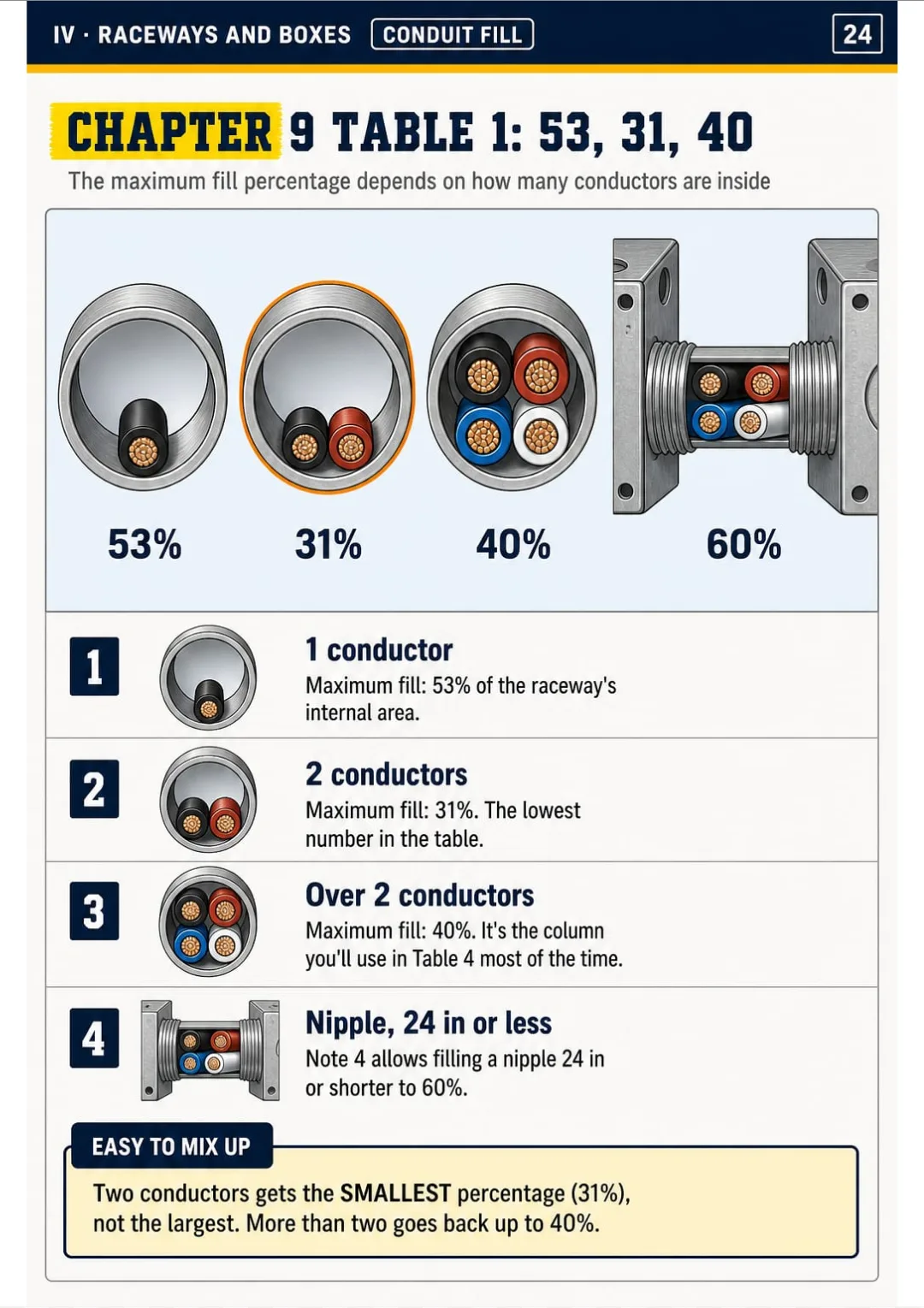
p. 24 · CHAPTER 9 TABLE 1: 53, 31, 40EASY TO MIX UP
Two conductors gets the SMALLEST percentage (31%), not the largest. More than two goes back up to 40%.
📄 Digital PDF book · read on your phone or print
Ohm's law and three-phase math, Table 310.16 ampacity, conduit and box fill, Article 250 grounding, dwelling load calcs, motors and working space at panels. You look at the drawing, read three short lines, and the callout tells you which NEC article or table to open next. 57 pages in 8 parts.
Price US$ 27 US$ 63
🔒 Secure checkout · PDF by email · 30-day guarantee
The same topic, explained two ways.
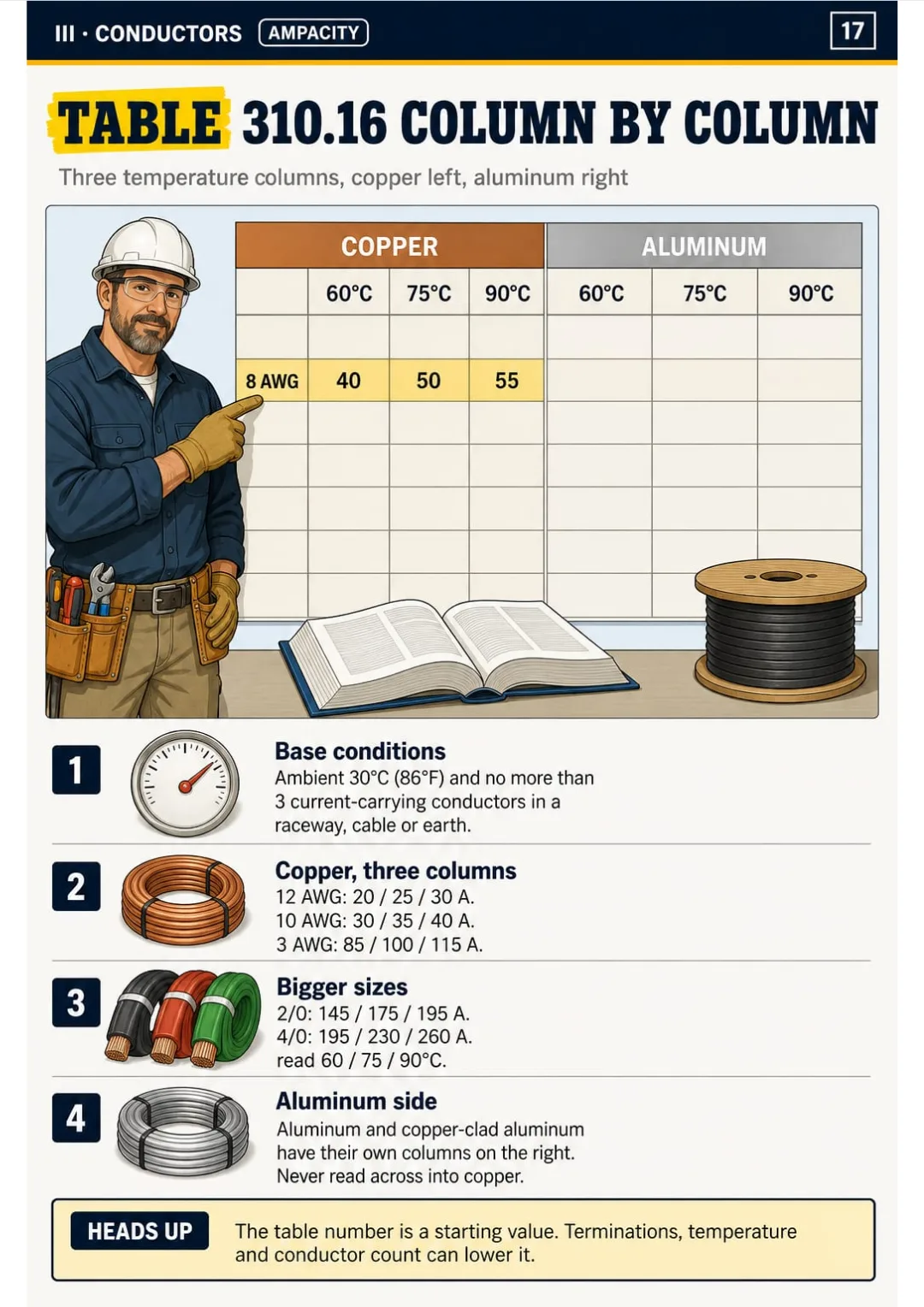
You're on a job site with the panel cover off. The plans call for a circuit with 8 AWG copper, 90 °C insulation, and the equipment terminals are rated for 75 °C: which column of the table do you read?
You could flip through the code book and hope the article shows up, or ask the journeyman, who is two floors up. The explanation you find says it in paragraphs: the insulation rating, the terminal rating, the temperature limits.
In the book, Table 310.16 is one page. Copper sits on the left and aluminum on the right, each with three temperature columns, and a box reminds you that the table number is only a starting value: terminations, temperature and conductor count can lower it.
The rest works the same way: conduit fill, grounding, motor circuits, working space at the panel. Each one has its own page.
You look at the page, pick the column and get back to the panel, without rereading the whole article.
One big drawing per page, with a box of what to remember.
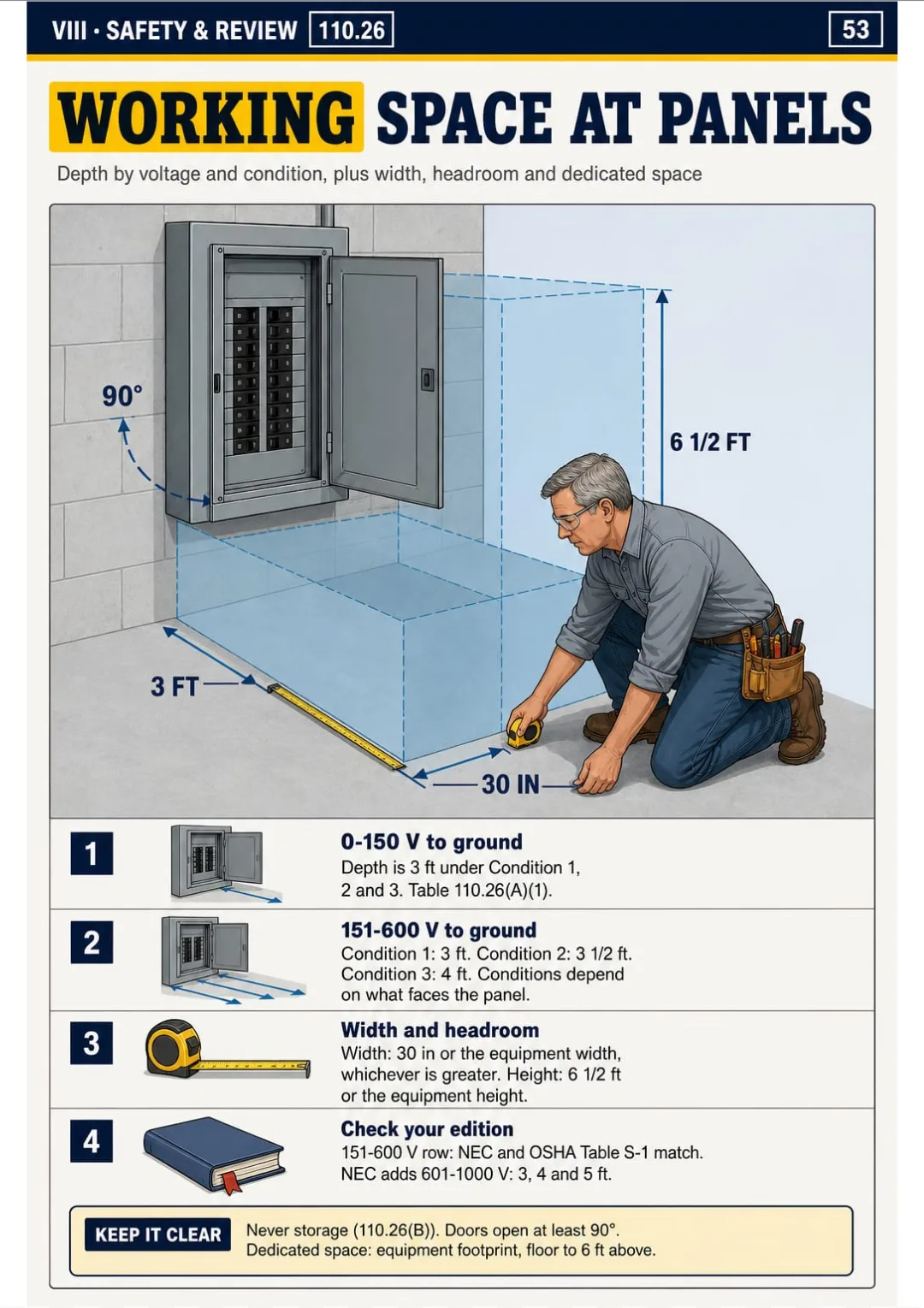
These are real pages from the book. The table of contents is the full one: 8 parts and 53 topics.
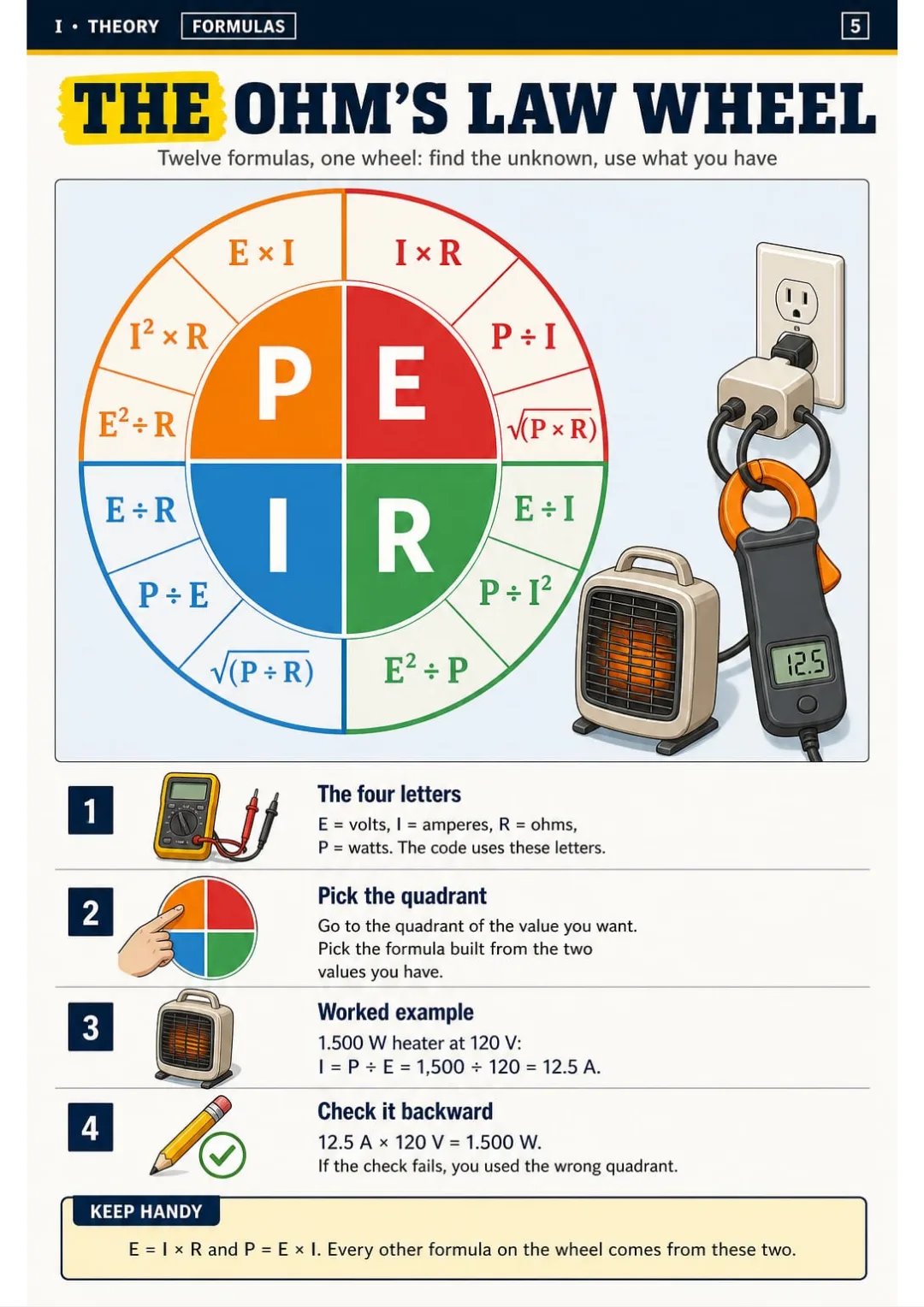
The Ohm's law wheel, series and parallel, single- and three-phase, the 1.732, transformer ratios and voltage drop in four steps.
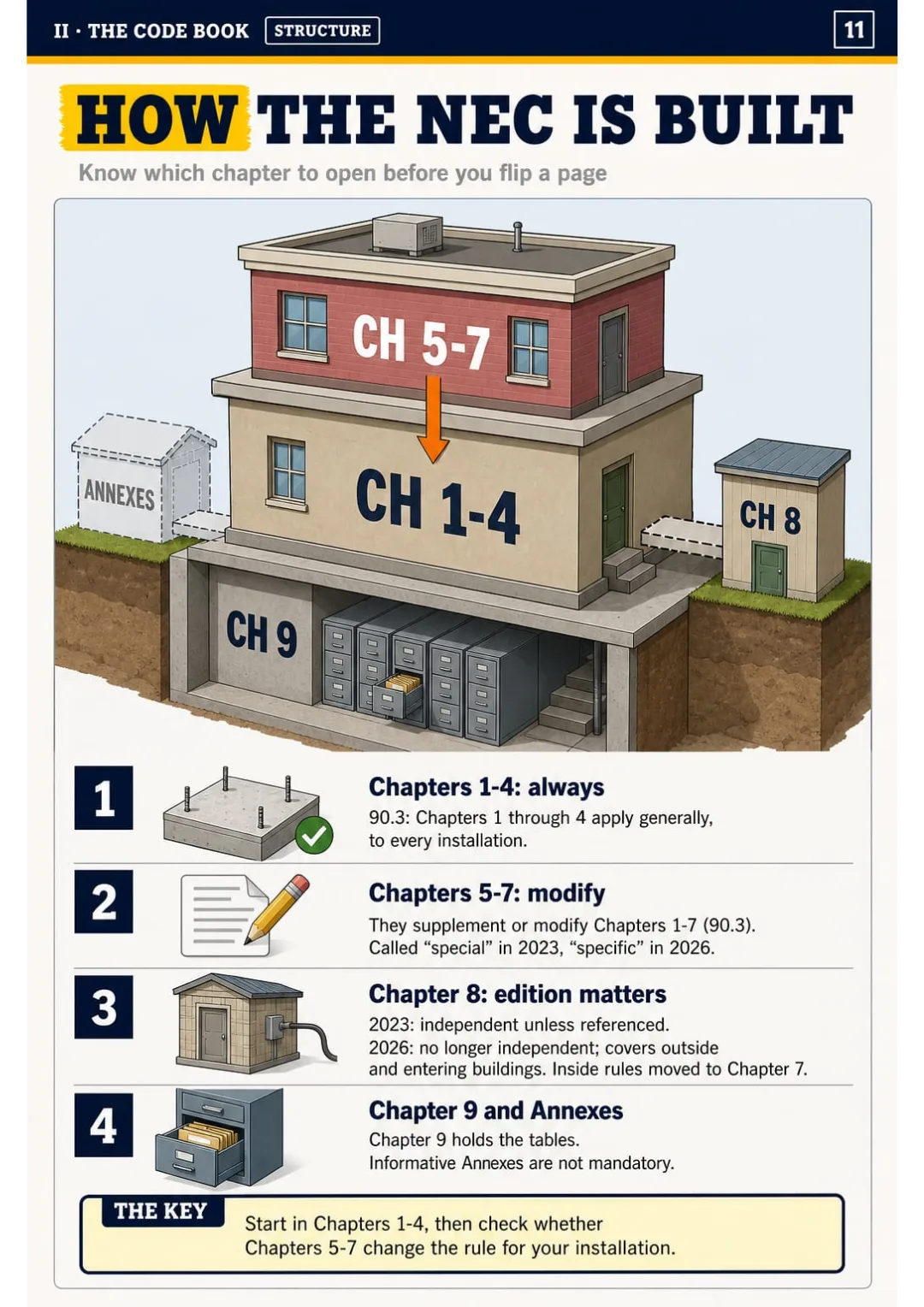
How the NEC is laid out (90.3), Article 100 definitions, the index vs. the table of contents, table notes and exceptions, your state's edition and tabbing the book.
Table 310.16 column by column, terminations, the small-conductor rule, ambient correction, adjustment for bundled conductors and continuous loads at 125%.
Chapter 9 Table 1, conduit fill in a fixed order, box fill counting and volumes, supports and bends, and burial depth from Table 300.5.
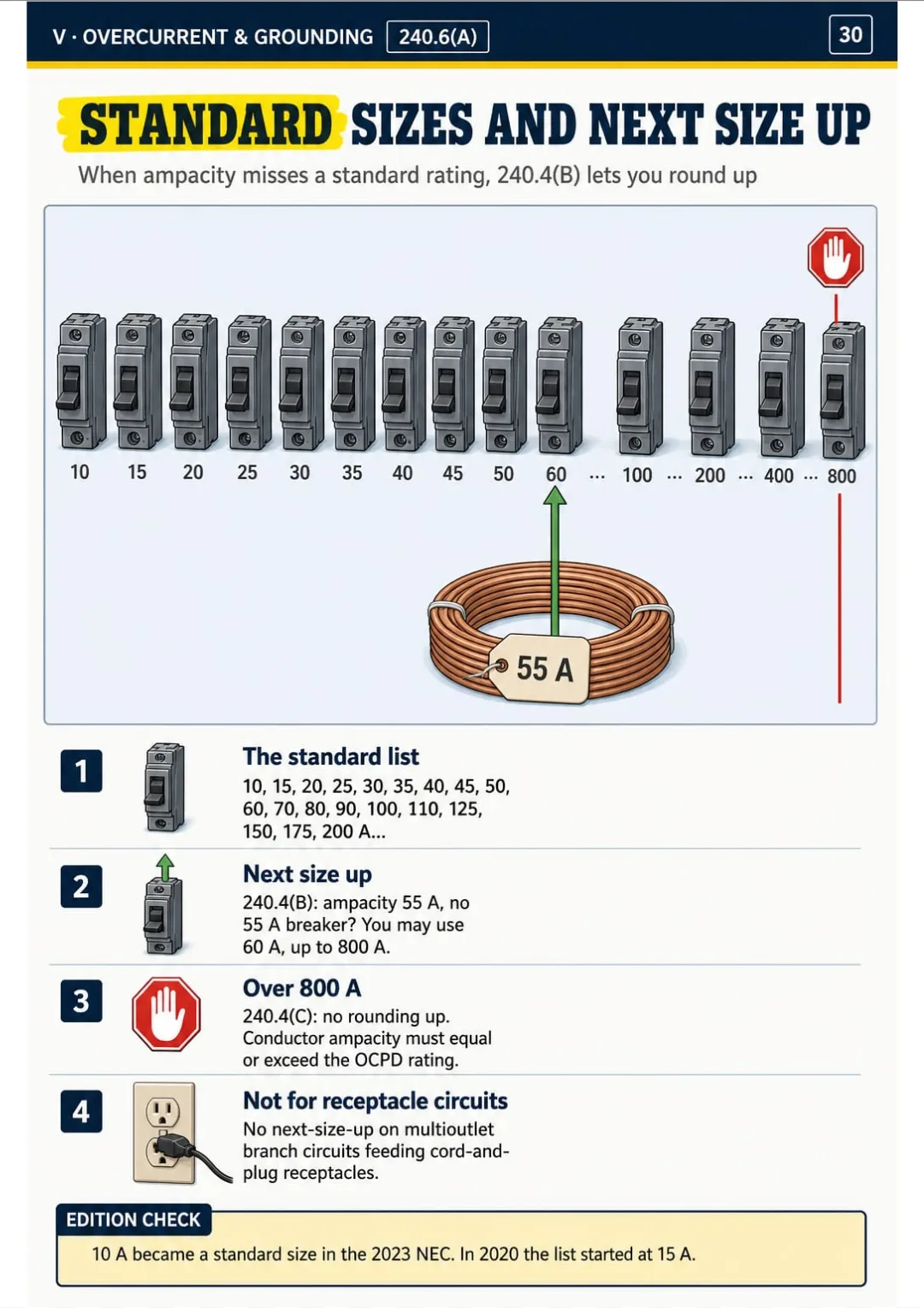
Standard breaker sizes, grounding vs. bonding, GEC and EGC sizing, the electrode system, bonding jumpers and the single neutral-ground bond.
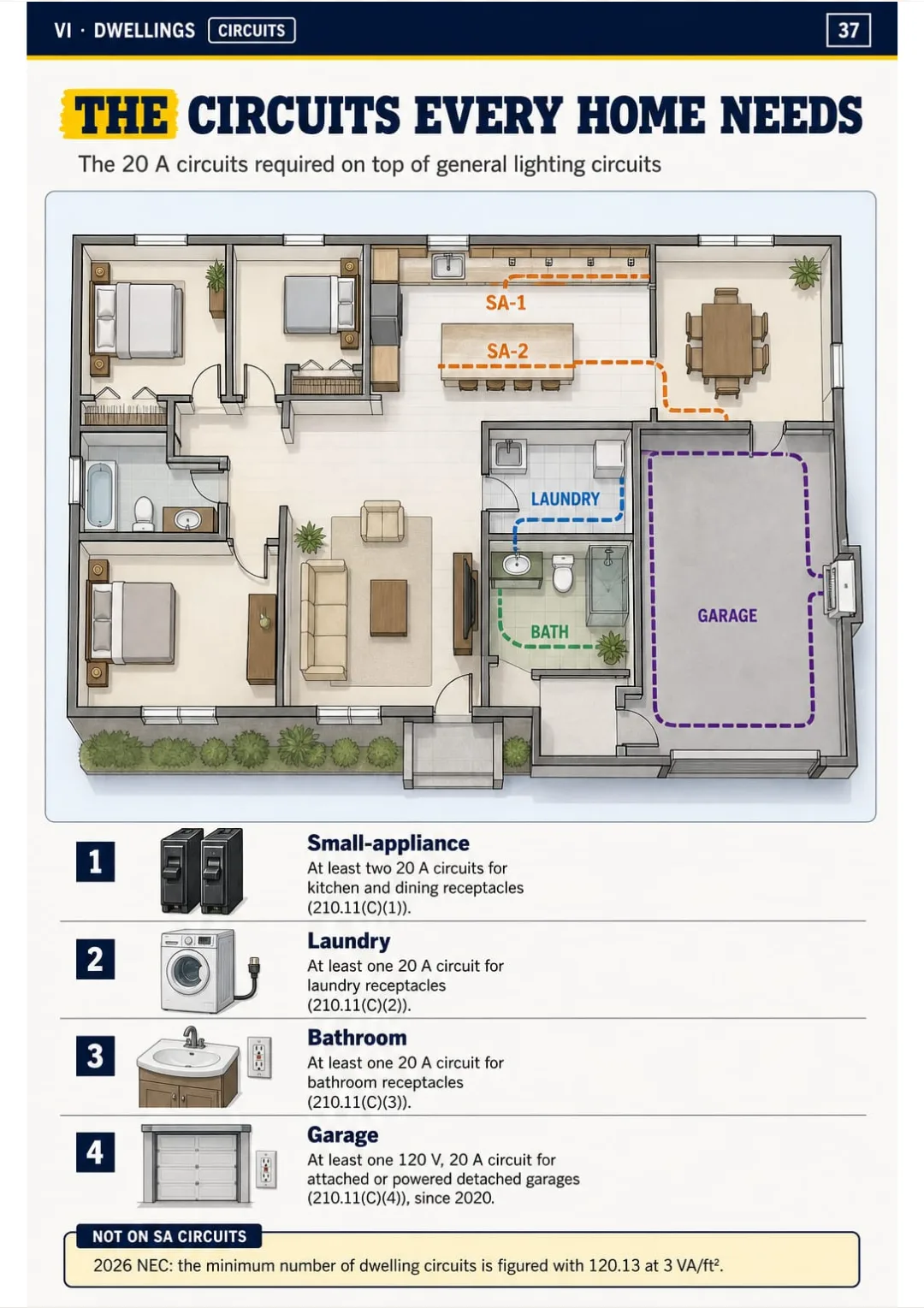
Required dwelling circuits, the 6-12 receptacle rule, countertops, GFCI and AFCI, the dwelling load calc in three steps and the optional method.
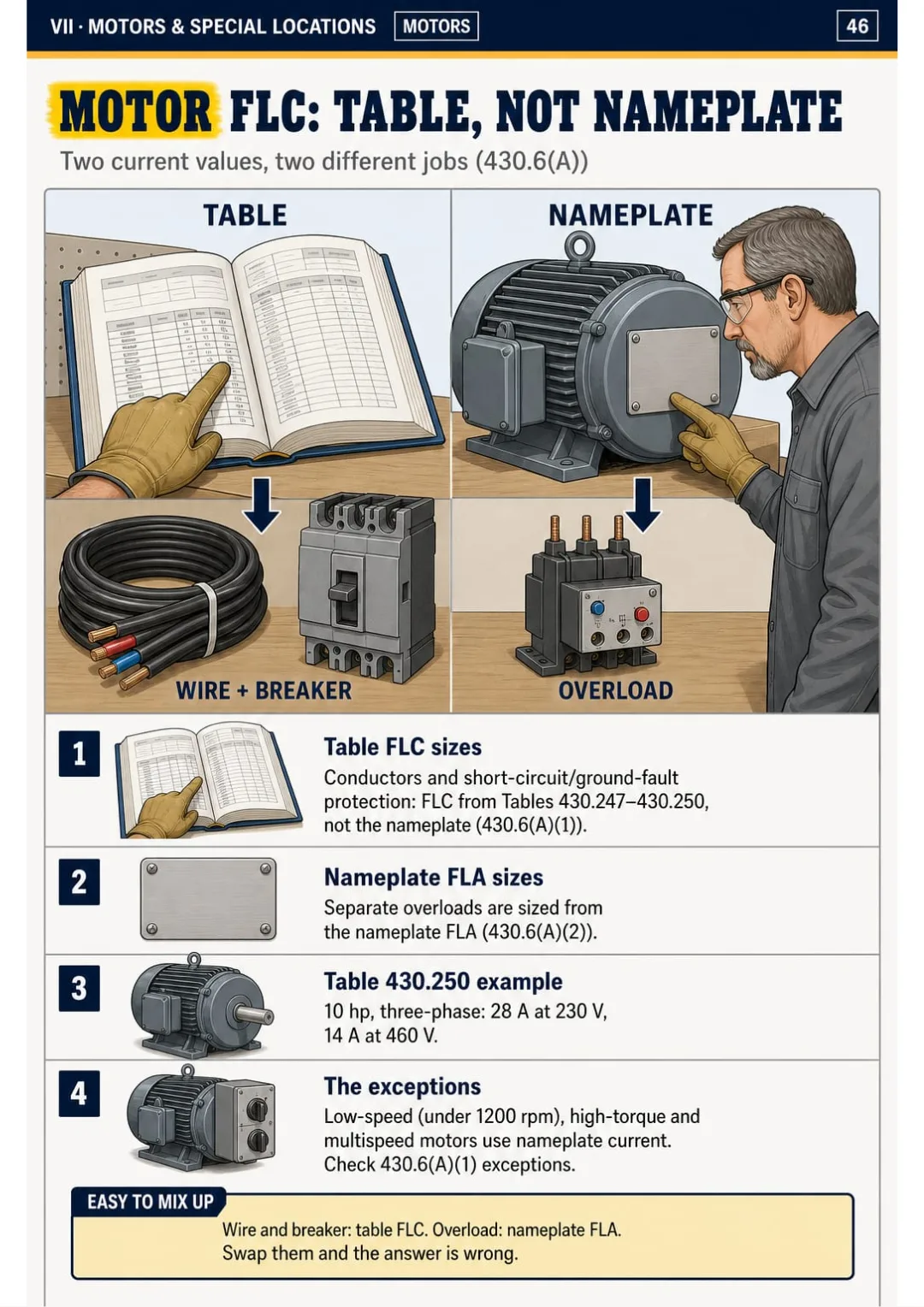
Motor FLC and protection, transformer overcurrent protection, hazardous locations, pools and equipotential bonding, and service drop clearances.
Working space at panels, NFPA 70E boundaries, OSHA on the job site, lookup vs. calculation on the job, and the most frequent mistakes on one page.
At the end of the book: A page on lookup vs. calculation and a one-page review of the most frequent mistakes
Price US$ 27 US$ 63
Every page ends with the mix-up that trips people up.
Two conductors gets the SMALLEST percentage (31%), not the largest. More than two goes back up to 40%.
Wire and breaker: table FLC. Overload: nameplate FLA. Swap them and the answer is wrong.
Free with your book today.

Check yourself with questions from the job, each answer explained and tied to the NEC article or table where you'd find it.

The articles and tables worth tabbing, on one sheet you can print and keep next to your code book.
📄 This is a digital PDF book sent to your email: nothing is printed or shipped.
PDF by email: We email you Home Wiring in Practice as a PDF, together with the two free books. It's a single payment: no installments, no extra charges.
Try Home Wiring in Practice for 30 days, bonus books included.
We refund everything if the file won't open, if the book isn't what you see here, if you were charged twice or if the email doesn't arrive. Just email us.
You pay once. No subscriptions.
Pick the one that sounds like you.

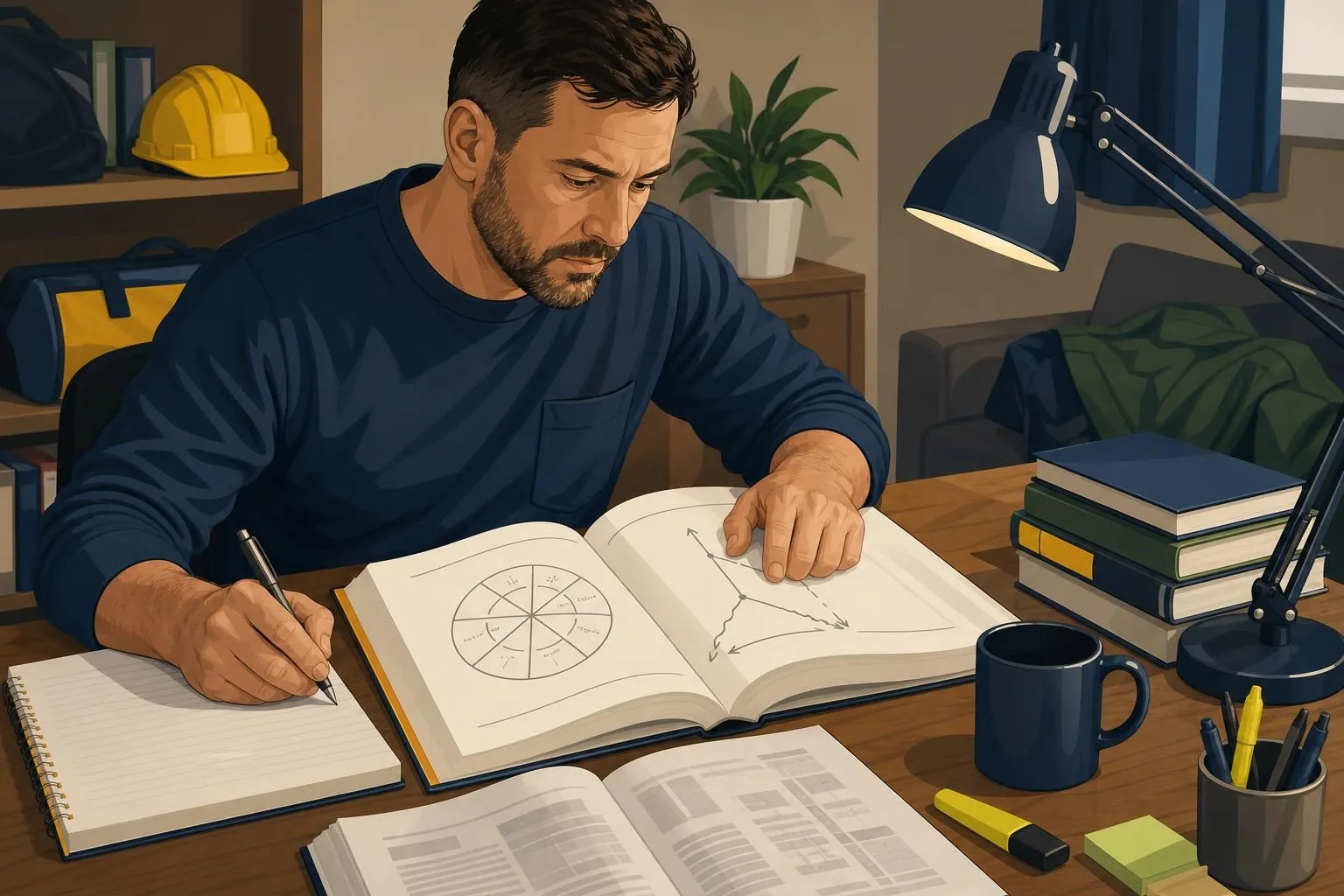
You do the work every day, but the code text slows you down. The Table 310.16 page shows you which column to read, with the terminal rating right in the drawing.
The Ohm's law wheel and the 1.732 of three-phase each get one page, so a 1,500 W heater at 120 V becomes 12.5 A in seconds.

Each calculation runs in the same order, and every page names the article or table to open, like Table 250.66 for the grounding electrode conductor.
Quick answers before you decide.
Both. The first part builds the theory from Ohm's law, and the rest is organized by what you look up on the job. If you've wired for years, most pages are about finding the answer in the code and working the calculations: load calcs, conduit and box fill, grounding and motor protection.
The book and the two bonuses come as PDFs by email.
Yes. You pay once and there's no subscription.
No. It sits next to the code book and points you to the article or table. You still need the official NEC edition your state uses, your training hours and your state board's requirements. It doesn't come with a certificate or count as continuing education hours.
From NFPA 70 (NEC), NFPA 70E, OSHA 29 CFR 1910 Subpart S and 1926 Subpart K, and state licensing board candidate bulletins. Pages cite article and table numbers; they don't reproduce the code text.
Article and table numbers follow the 2020 and 2023 NEC. Where a rule changed between editions, like the 20 A garage circuit added in 2020, the page says so. Check which edition and state amendments your jurisdiction has adopted.
Yes, you can print the PDF at home and take it to the job. Check your state's and your employer's rules before you tab your code book with the cheat sheet.
No. It's independent study material and isn't affiliated with or endorsed by NFPA. NEC and National Electrical Code are registered trademarks of NFPA.
You have 30 days. We refund everything if the file won't open, if the book isn't what you see on this page, if you were charged twice or if the email doesn't arrive: just email us.
It's a PDF: read it on screen or print it
One book, one page per topic and 30 days to try it.
Start with the first page.
One-time payment: US$ 27 · Guarantee: 30 days · PDF by email
I want Home Wiring in Practice for US$ 27📄 This is a digital PDF book sent to your email: nothing is printed or shipped.